As a local law firm supporting international investors, Viet An Law is committed to delivering accurate, practical, and optimal legal solutions throughout the company establishment process in Vietnam
Viet An Law Firm
18 years of formation and development
Viet An Law was established under the following official registrations:
Certificate No.01010266/TP/DKTP issued in 2007 by the Hanoi Department of Justice
Certificate No.1448/QĐ-SHTT issued in 2007 by the Vietnam Intellectual Property Department
Certificate No.06.2504/TP/ĐKHĐ issued in 2016 by the Ho Chi Minh City Department of Justice
Confirmation No.9316/XN-CT-TTHT issued in 2020 by the Hanoi Tax Department
We operate from our head office in Hanoi, with an additional branch office in Ho Chi Minh City.
Providing reliable legal support for businesses of all sizes.
Deep legal expertise
Combining Vietnamese and international professional experience.
Comprehensive legal services
Delivering complete solutions that are fast, accurate, and effective.
Client-centric approach
Understanding your needs, offering practical advice, and optimising both solutions and costs.
ABOUT OUR SERVICES
Set up a new company in Vietnam
As Vietnam has become one of the most attractive investment destinations, supported by new-generation free trade agreements such as the CPTPP and EVFTA, along with a continuously improving business environment, the demand for company establishment by foreign investors has grown rapidly.
To help investors enter the Vietnamese market quickly, lawfully, and at optimal cost, Viet An Law Firm offers comprehensive and in-depth legal support. This service goes beyond simply outlining administrative procedures. We analyse the legal framework, highlight common risks, and propose strategic solutions to ensure an efficient and sustainable company formation process.
As a local law firm supporting international investors, Viet An Law is committed to delivering accurate, practical, and effective legal solutionsthroughout the entire process of establishing a new company in Vietnam.
Common legal risks and how to avoid them when setting up a company in Vietnam
Through our consulting experience, we have observed that many investors fall into serious traps due to limited understanding or reliance on informal and unverified advice.
1. Nominee Investment Structures
Some investors attempt to avoid the Investment Registration Certificate (IRC) process by asking a Vietnamese individual to hold shares on their behalf. This practice is illegal and carries significant risks. In cases of disputes, Vietnamese courts frequently deem such “nominee agreements” or name-based transactions invalid, which may result in the foreign investor losing control or even ownership of all invested assets.
2. Virtual Business Locations
Some investors attempt to register their head office using a residential address or a non-existent location. This can trigger inspections by the tax authorities. If the business is found not to be operating at the registered address, the tax code may be suspended, which can cause serious operational and legal issues.
3. Sub-Licenses
Many investors assume that obtaining an Enterprise Registration Certificate (ERC) automatically allows them to operate. In reality, certain industries, such as retail, education, healthcare, and logistics, require additional approvals, including a Business Eligibility Certificate, Retail Establishment License, or other sector-specific permits. Failing to secure these licenses can lead to fines, suspension, or other regulatory penalties.
Tax updates
For the newly established businesses in Vietnam – 2025
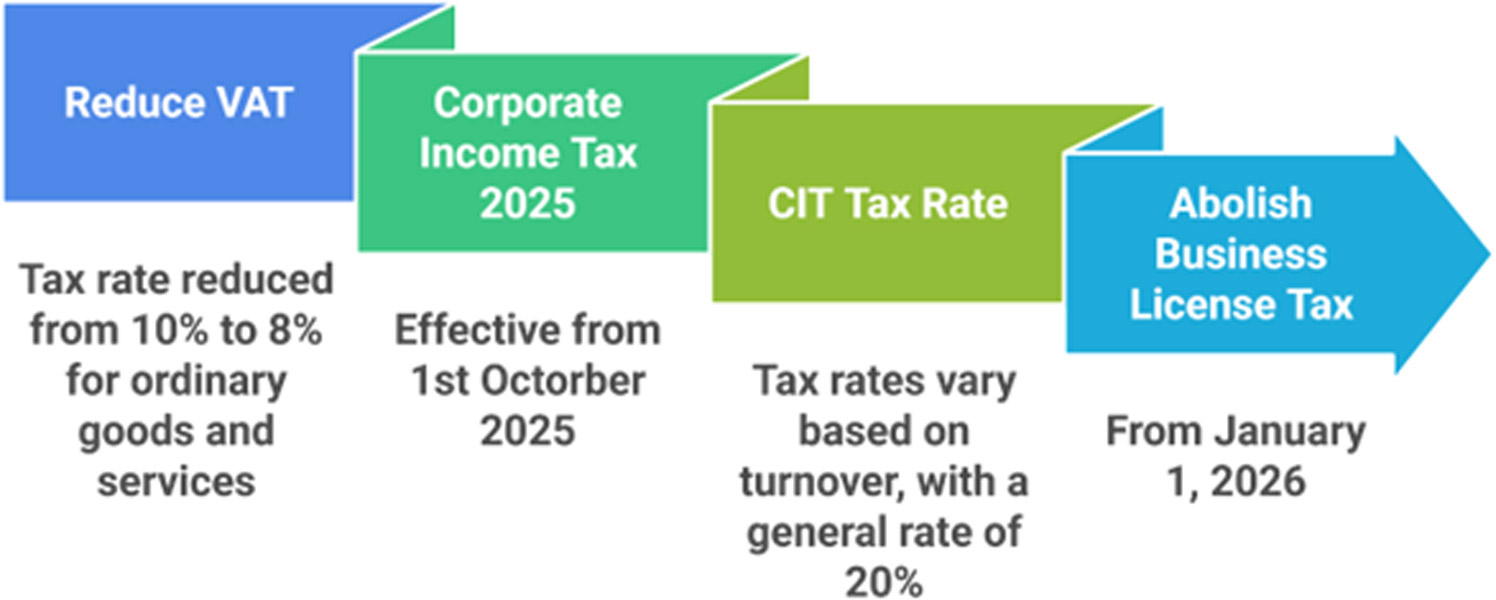
Value Added Tax (VAT): VAT is only payable when there is a positive difference between the input and the output VAT. Rates range from 0% to 10% depending on the goods or services involved. Standard goods and services remain at 10%, but will continue to enjoy a temporary reduction to 8% under the National Assembly’s Resolution, effective from July 1st, 2025, to the end of 2026.
Corporate Income Tax (CIT): The Corporate Income Tax Law 2025 takes effect from October 1, 2025, applying to the 2025 tax period. New CIT rates are as follows:
20% - General corporate income tax rate
15% - For enterprises with annual revenue under VND 3 billion
17% - For enterprises with annual revenue from VND 3 billion to VND 50 billion
Business License Tax: Under Resolution 198/2025/QH15, effective January 1, 2026, the business license tax (also known as the business license fee) for business households, individual businesses, companies, and enterprises will be officially abolished (Clause 7, Article 10).
Procedure for setting up a new company in Vietnam
Phase 1
Apply for Investment Registration Certificate (IRC)
This is the project appraisal step. The state authority will review the legality, financial capacity, and location of the project. Documents must demonstrate financial capacity (bank balance confirmation, audited financial statements).
Phase 2
Apply for the Enterprise Registration Certificate (ERC)
After having the IRC, engrave the seal and register the company’s account.
Phase 3
Capital contribution according to progress
Contribute the full capital within the deadline recorded in the Investment Registration Certificate (IRC). If you do not contribute on time, you must apply for an extension to avoid being fined.
Phase 4
Post-Incorporation & Legal Compliance
Initial tax registration
Employee registration
Social insurance registration
Company signage installation
Application for sub-licenses (if required for the business sector)
📌 An important note
An important note is that for the form of M&A (Capital contribution, share purchase), foreign investors may not need to apply for IRC, but only need to carry out the procedure of registering capital contribution and share purchase. This is an option that should be considered when establishing a new company in Vietnam to shorten the time to enter the market.
For investment through M&A activities (capital contribution or share purchase), foreign investors may not be required to obtain an Investment Registration Certificate (IRC). In these cases, only the capital contribution/share purchase registration procedure is needed. This approach is often worth considering when entering the Vietnamese market, as it can significantly shorten the market-entry timeline compared to establishing a new company through the standard IRC process.
Impressive figures
18
Years of experience
10
Partners
800
Corporate clients & business partners
5000
Trusted clients
Documents foreign investors need to prepare to set up a new company in Vietnam
To carry out the procedures for applying for the IRC and establishing a foreign-invested company in Vietnam, investors must prepare the following groups of documents:
Investor's legal documents
For individual investors:
A notarised copy of a valid passport (if issued abroad, consular legalisation may be required).
For institutional/corporate investors:
Certificate of Business Registration or Certificate of Establishment (notarised and consular legalised).
A passport of the legal representative or the authorised representative in Vietnam.
Power of Attorney/Authorisation Letter (if the signatory is not the legal representative).
Documents proving financial capacity
Investors must provide one of the following to demonstrate sufficient financial capability for the proposed investment capital:
Bank account balance confirmation (at least equal to the planned investment capital; consular legalisation and translation may be required).
Audited financial statements for the last 2 years (consular legalisation for foreign documents).
Parent company guarantee letter.
Written commitment of financial support from credit institutions or international financial institutions.
Project site documentation
Office/headquarters lease agreement or documents proving the right to use the proposed project location in Vietnam.
Legal documents relating to the leased property (e.g., Land Use Rights Certificate, Construction Permit), if required by the licensing authority during review.
Preliminary information about the investment project
Project objectives and scope of activities
Investment scale and total registered investment capital
Information on contributing investors, including contributed capital amounts and ownership ratios
Project implementation timeline, including capital contribution schedule and operational milestones
Labor demand
Land or office space requirements
Assessment of socio-economic impacts and the project’s expected effectiveness
Frequently Asked Questions (FAQ)
Viet An Law Firm receives many questions related to setting up businesses. Below are the most asked questions:
Is it possible to choose the display date on the Enterprise Registration?
Companies may select a preferred submission date to appear as the official registration date on the Enterprise Registration Certificate. However, this date cannot fall on weekends or public holidays. It is important to note that the chosen date cannot be guaranteed with 100% certainty and may involve certain risks during processing. If you wish to select a specific registration date, you can contact Viet An Law Firm for tailored advice and the most effective support.
Where are the company establishment dossiers submitted?
For individual business households: Clients submit their dossiers to the District People’s Committee in the location where the business household will operate.
For companies: The dossier is submitted to the Enterprise Registration Office under the Department of Planning and Investment in the province or city where the company’s head office is located.
Does setting up a company require permanent residence?
No. Setting up a company does not depend on the founder’s permanent residence. A founder can set up a company in any province or city, depending on business needs.
How much capital is required to set up a company?
Under the current Enterprise Law, the amount of charter capital is fully determined at the enterprise’s discretion. The company is responsible for declaring its charter capital and bearing all corresponding liabilities. For certain conditional business sectors with legally prescribed minimum capital requirements, the enterprise must register capital aligned with those regulations. However, you do not need to prove the source of capital. You just have to ensure you can take responsibility for the declared amount and maintain sufficient capital where specific industries require it.
Can an apartment building be registered as the company’s head office?
No. Under current regulations, apartment buildings and collective residential housing cannot be used as the registered head office of a company, or as the address of its branch, representative office, or business location. You need to pick a location that is legally approved for business use (office buildings, commercial properties, etc.).
Reviews from customers
01 /
Thank you Vietanlaw for your great service over the years.
Mr. Yamakawa
HSC Japan
Outstanding support from start to finish. The team guided us through every legal requirement, tax registration, and banking setup. Their expertise saved us months of confusion and costly mistakes.
Ms. Sarah Johnson
Green Trading Co.
Law Company made our Vietnam market entry seamless. They handled all licensing, registration, and compliance efficiently. Our company was operational within three weeks. Highly professional service throughout.
Mr. Michael Chen
TechVision Solutions
Exceptional experience opening our Vietnam branch. Law Company provided clear timelines, transparent pricing, and constant communication. They truly understand foreign investment procedures and local business regulations perfectly.
Mr. David
Pacific Group
Professional, efficient, and reliable. They simplified the entire company formation process, from investment certificate to business license. Their bilingual team made communication effortless. Absolutely recommend their services.
Ms. Rodriguez
Consulting International
Best decision choosing Law Company for our Vietnam setup. They handled documentation, notarization, and government liaison expertly. Smooth process with no hidden fees. Our business launched ahead of schedule.
Mr. James Park
Innovation Tech Hub
01
Customers
01 /
01
The leading consultancy law
Viet An Law Firm
Hanoi Head-office
3rd Floor, Hoang Ngan Plaza Building, 125 Hoang Ngan
Yen Hoa Ward, Ha Noi City